Inside the Bloom: How Light Roasts Carry High-Frequency Flavor
Light roasting is misunderstood.
To some, it’s just less time in the drum.
To others, it’s acidity without depth.
But when handled with discipline, a light roast becomes something else entirely — a high-frequency structure capable of carrying florals, citrus oils, and honey resonance without collapsing into fragility.
At Anarko, we call this space the Bloom.
And the Bloom is engineered.
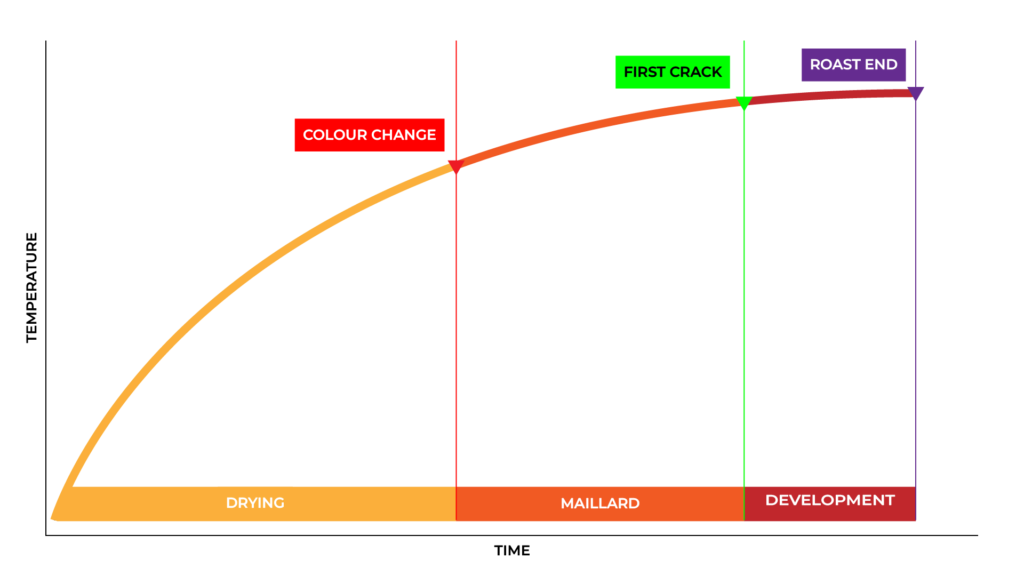
The Maillard Window: 4:00–6:30
Maillard is where sweetness is born.
Between four and six-and-a-half minutes, sugars and amino acids begin their controlled transformation. Too short, and the cup feels hollow. Too long, and brightness begins to mute under caramel weight.
For high-frequency blends like Kivu Sky BloomEngine, Maillard is extended with intention — not to darken, but to stabilize.
This window builds internal scaffolding.
It allows floral compounds to sit on structure instead of floating unanchored. It gives citrus something to resonate against. It turns potential sharpness into harmonic lift.
We are not racing through Maillard.
We are shaping it.
Development: 10–12% and No More
Development time — the stretch after first crack — is restraint.
For light-to-light-medium roasts, development sits at 10–12% of total roast time. This is the narrow edge where clarity survives.
Push development further and volatile aromatics begin to degrade. Florals flatten. Honey turns generic. The cup descends.
Cut it too short and structure collapses. Acidity spikes without integration.
At 10–12%, we preserve the high notes while allowing just enough internal caramelization to give body. The goal isn’t weight.
It’s lift with spine.
Floral Compounds Under Gentle Heat
Florals are fragile.
Many of the compounds responsible for jasmine, bergamot, citrus peel, and blossom aromatics are volatile. They evaporate quickly under aggressive heat. They disappear under prolonged development.
That’s why charge temperature and energy application matter.
By maintaining a disciplined charge window (395–402°F) and controlling rate-of-rise through early drying, we prevent thermal shock. The goal is even energy transfer — no scorching, no stalls.
Gentle heat is not weak heat.
It is controlled heat.
And control is what preserves bloom.
The Drop: 395–402°F
Drop temperature is not a number pulled from preference.
It is a boundary.
Below 395°F, structure may remain underdeveloped. Above 402°F, we risk muting the very frequencies we’re trying to carry.
Within this narrow band, citrus oils remain articulate. Honey-malt sweetness stabilizes without drifting into generic caramel. Florals remain lifted instead of baked.
The drop point is where we decide whether the cup ascends or settles.
We choose ascent.
Mystic and Technician
There is a myth that you must choose between poetry and precision.
We reject that.
At Anarko, the ritual language is real — because the math is real. Frequency is not metaphor alone. It is balance, timing, restraint, and repetition.
High-frequency flavor isn’t accidental.
It’s the result of:
- Controlled Maillard timing
- Tight development windows
- Disciplined drop temperatures
- Respect for volatile compounds
Light roasting is not less roasting.
It is more attention.
The Bloom Is Structure
When you taste floral-citrus-honey resonance in a light roast, you’re not tasting brightness alone.
You’re tasting geometry.
You’re tasting restraint.
You’re tasting a curve designed to carry high notes without letting them fracture.
Inside the Bloom, heat becomes alignment.
And alignment becomes lift.